
What Key Investment Terms Do You Need in Your Investment Fund or Syndication?
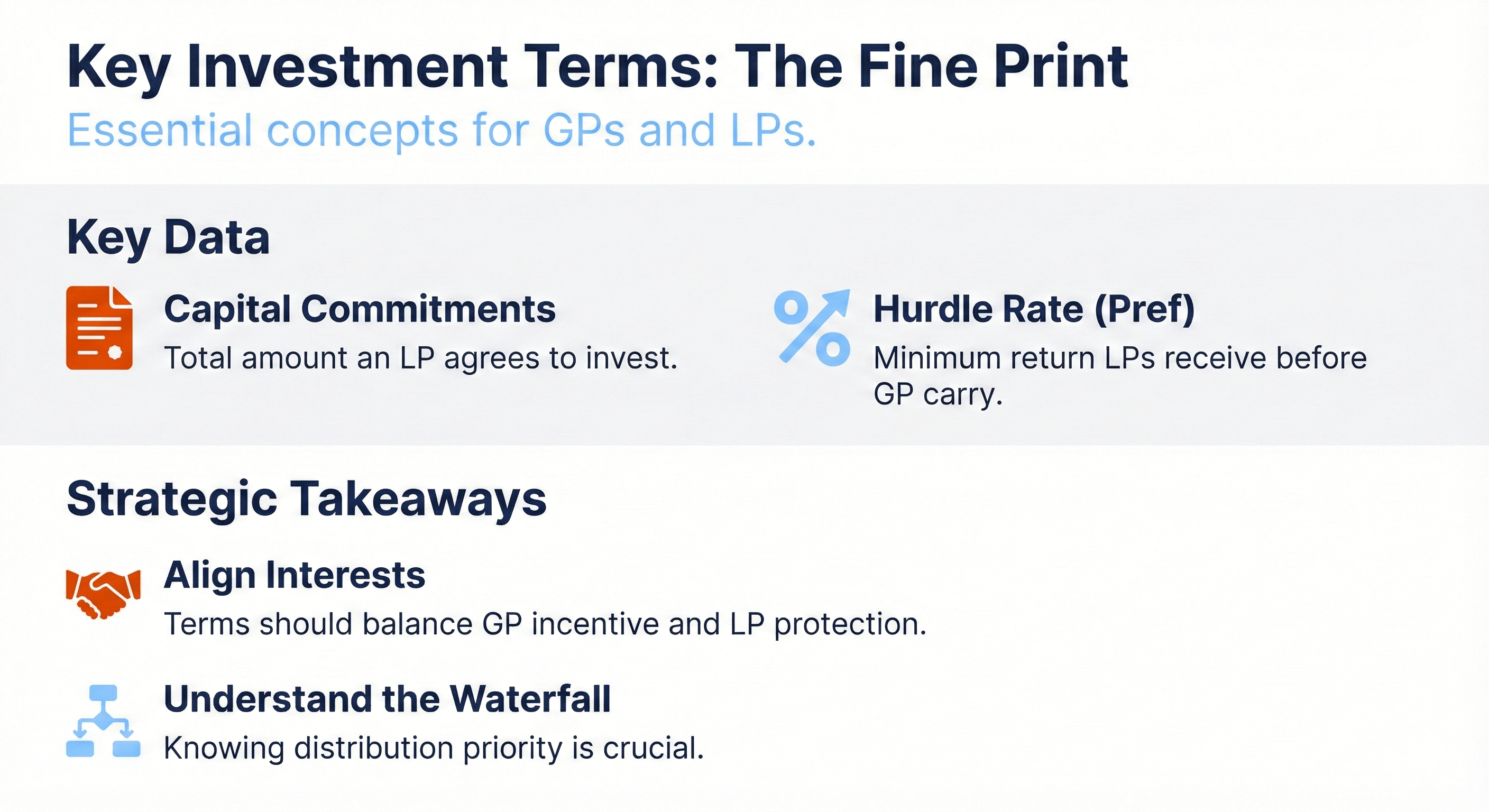

Once you decide on your fund’s basic structure, it’s time to zoom in and finalize the details. In this chapter, we’ll discuss twenty key business terms you’ll need to research, consider, and select for your fund or syndication.
1. CARRIED INTEREST
Carried interest is the share of the fund’s profits the GP gets to keep. The LPA’s distribution waterfall determines how the GP and the LPs split the money. Unlike the management fee (discussed below), carried interest is not guaranteed, and the GP may end up earning no carried interest if the fund isn’t profitable. We’ll discuss carried interest and distribution waterfalls in detail in Chapter 7 (you’re almost there).
2. MANAGEMENT FEES
The management fee is a recurring fee paid by the fund. Typically, the management fee is paid to the ManCo pursuant to a management-services agreement entered into by the fund, the GP, and the ManCo. Management fees have two main components:
- Management Fee Percentage: The percentage charged.
- Management Fee Base: The “base” on which the management fee percentage is charged.
The typical management fee percentage and base differ based on the fund’s asset class. For example, the following are common management fee bases:
- Closed-End Venture Capital Fund: Committed capital
- Closed-End Real Estate or Private Equity Fund: Committed capital during the investment period; invested capital thereafter
- Closed-End Private Credit Fund: Invested capital
- Open-End Fund: Net asset value or assets under management
In most funds, there is a reduction in the management fee when the investment period ends. We touched on this in Chapter 2.
In a private equity fund, for example, the management fee base decreases (as shown above). So, the management fee might be (i) 2 percent of committed capital during the investment period, and (ii) 2 percent of invested capital thereafter.
In a venture capital fund, however, the management fee base typically stays the same (committed capital), but the management fee percentage decreases. For example, the management fee might be (i) 2 percent of committed capital during the investment period, and (ii) 1.5 percent of committed capital thereafter.
3. OTHER AFFILIATED FEES
The fund documents should clearly and carefully disclose any other fees paid to the GP, the ManCo, or their affiliates. As discussed in Chapter 2, examples of common fees (with typical ranges) include:
- Acquisition fees (1–2 percent of gross acquisition price)
- Guarantee fees (0.5–1 percent of guaranteed indebtedness)
- Disposition fees (1 percent of gross sales price)
- Property management fees (3–7 percent of rents)
- Development fees (5 percent of the costs of development)
The ranges above are merely examples. You may see higher or lower fees in the wild. Real estate funds normally have one or more of the above fees, while other types of funds, such as venture capital funds, usually do not have any of them.
4. FUND TERM
The fund term is how long the fund lasts. A closed-end fund might last ten years, while an open-end fund could last forever. See Chapter 5 for an in-depth review of typical fund terms.
⚠ FUND TRAP #6: TRYING TO REINVENT THE WHEEL
Every once in a while, I’ll have a client who wants to do something completely different and invent a novel structure with creative terms. While I applaud the ingenuity, clients are often most successful by coloring inside the lines. If you need to spend hours explaining to LPs how your fund works (and why it’s different from a “normal” fund), you might want to consider moving toward a more typical structure. (By the way, coming up with a novel fund structure is an excellent way to increase your legal bill.)
I once had a client that wanted to raise a thirty-year closed-end fund. They were excited about the tax benefits of not needing to constantly buy and sell assets. They could keep the best assets, which would benefit LPs!
However, fundraising was difficult. Most LPs weren’t excited by the prospect of having capital locked up for thirty years without any prospect for liquidity until…2050. Ultimately, the client moved toward a more standard (but still long) fund term of twelve years (plus a two-year optional extension at the GP’s discretion), and their fundraising success improved.
It’s often best for GPs to differentiate themselves on their thesis, deal flow, and execution—not via novel legal documents.
5. INVESTMENT PERIOD
The investment period is the period during which a closed-end fund can make new investments. It’s typically the first half of the fund term. See Chapter 5 for an in-depth review of a typical fund investment period.
6. SUBSEQUENT CLOSINGS
How will new LPs be admitted after the initial closing date? As discussed in Chapter 5, most closed-end funds have a final closing date after which no new LPs can join.
Many closed-end funds require LPs admitted after the initial closing date to pay late fees. These late fees are paid to the early LPs to compensate them for taking the risk earlier (and to recognize the time value of money). We’ll discuss the mechanics of admitting LPs after the initial closing date in detail in Chapter 11.
7. FUND EXPENSES
Fund expenses are costs paid directly by the fund (i.e., the LPs and the GP to the extent of their own capital commitment). We discussed fund expenses in detail in Chapter 2.
8. GP COMMITMENT
How much money is the GP putting into the fund? The bare minimum is typically 1 percent of the fund size, but many GPs put in much more. Occasionally, you’ll see a fund or syndication where the GP has no capital commitment. Unsurprisingly, LPs prefer larger GP commitments. As discussed in Chapter 2, GPs can get creative in how they fund their commitment, including cash contributions, property contributions, and waivers of fees (like management fees or acquisition fees).
9. GP REMOVAL
Can the LPs remove the GP? Sometimes. Here are the two primary options:
- Removal for Cause: Many funds give LPs the right to remove the GP if the GP commits a “cause event” (something really bad, like fraud or material violation of securities laws). The required LP vote to remove for cause might be anywhere from 51 to 66 percent.
- Removal for Any Reason: A smaller number of funds let the LPs kick out the GP for any reason. The required LP vote to remove for any reason is often higher, perhaps 66–85 percent. In addition, for “no cause” removal, the right to remove might only begin a year or two after the fund starts. That way, the LPs can’t kick out the GP without giving the GP a fair chance to perform.
As you can imagine, the definition of “cause” is highly negotiated, with GPs wanting a narrower version of “cause” and LPs negotiating a broader set of events (such as gross negligence) that can be considered a cause event.
10. KEY PERSON EVENT
Many funds require the “key persons” (the individuals running the fund) to dedicate a certain amount of time to the fund. Examples of key-person time commitments include:
- Substantially all of their business time
- A majority of their business time
- A substantial amount of their business time
- Remain “actively involved” in the affairs of the fund
If the required threshold of key persons (such as a majority) fails to uphold their time-commitment requirement, the fund often enters a “suspension period” during which the fund can’t make any new investments until the LPs vote to end the suspension period. It’s similar to the investment period ending.
11. INVESTMENT LIMITATIONS
Some funds have contractual limitations on what the fund can invest in or how much can be invested in a particular category. Examples of fund-wide investment limitations include:
- No more than 20 percent of commitments can be invested in a single investment
- No more than 20 percent of commitments can be invested outside the United States
- At least 75 percent of commitments must be invested in multifamily buildings in Utah
- No investments in public securities
- No investments outside North America
The LPs (or the LPAC—see #18, below) can typically waive these limitations under certain circumstances. In some cases, LPs might have their own unique investment restrictions in a side letter with the fund. If the fund were to make one of these excluded investments, the LP with the side letter would not participate in that investment. We’ll discuss side letters in Chapter 9.
12. LEVERAGE
Some funds have contractual limitations on how much debt the fund can incur. For example, a multifamily real estate fund might limit leverage to 50 percent of the total value of its assets. As discussed in Chapter 14, venture capital funds should limit their total indebtedness to 15 percent of the fund size to ensure they maintain a good “venture capital exemption” from the Investment Advisers Act. In practice, most venture capital funds don’t take on any debt (except potentially short-term “capital call facilities,” which enable the fund to draw down capital from a credit facility and repay the debt with capital called from LPs).
13. CO-INVESTMENTS
In some funds, LPs are given pro rata rights to invest in co-investments or follow-on investments with respect to the fund’s portfolio investments (or, potentially, outside investments).
For example, let’s say a fund invests in the Series A round of a tech company. Later, the fund has the opportunity to invest in the Series B round, but the allocation is more than the fund can invest by itself (for example, a $40 million allocation in a $100 million fund).
In this situation, the fund might spin up a syndication to invest in the Series B round and give each fund LP the right to invest in the syndication. In many cases, fund LPs would get preferential economic rights (such as reduced fees or carried interest) in the co-investment syndication.
14. SUCCESSOR FUNDS
Most funds prohibit the GP from raising a “successor fund” (the next fund) before the investment period is over (typically halfway through the fund’s life). “Successor fund” is usually narrowly defined to mean a fund substantially identical to the existing fund. For example, the principals of a private equity fund couldn’t raise another private equity fund until the fund’s investment period ends. However, they could raise a venture capital fund or a real estate fund.
15. LP WITHDRAWAL RIGHTS
In most closed-end funds, LPs can’t withdraw money before the fund term ends. They’re locked in. Open-end funds typically permit LPs to withdraw, subject to lockups (time-based restrictions) and gates (amount-based restrictions). For more on lockups and gates, see Chapter 5.
16. IN-KIND DISTRIBUTIONS
Can the fund distribute anything other than cash to the LPs? For example, restricted securities? Many funds limit “distributions in kind” (distributions of property instead of cash) during the fund’s life. We’ll discuss distributions in kind in more detail in Chapter 7. As you can imagine, distributions in kind are more common in venture funds and less common in real estate funds. LPs do not typically want distributions of apartment complexes.
17. GP CLAWBACK
Clawbacks require the GP to return any excess carried interest to the fund. Clawbacks are common in closed-end funds. We’ll discuss clawbacks in detail in Chapter 7.
18. LIMITED PARTNER ADVISORY COMMITTEE (LPAC)
Many funds have a Limited Partner Advisory Committee (LPAC) made up of the largest (or most strategic) LPs. The LPAC can approve certain actions under the fund documents and provide guidance to the GP. However, except as mentioned below, LPACs typically do not make investment-related decisions. The fund’s investment committee and LPAC are usually separate.
Matters requiring LPAC approval might include:
- Making an investment that would otherwise be prohibited
- Approving a transaction between the GP and the fund
- Extending the fund term or the investment period
- Ending a suspension period
An LPAC can be very helpful for the GP. In most cases, the LPs as a whole (voting based on commitments) can approve any of the matters above. However, taking a full LP vote is burdensome. By creating an LPAC of three to five engaged (and friendly) LPs, the GP can get things approved much faster and more easily.
19. REPORTS TO LPS
What financial and other informational reports will be given to LPs? What are the time limits for producing and distributing them? Many funds provide annual financials, quarterly financials, and K-1s. They also provide general updates and market reports.
While some funds are required to provide audited annual financial statements, many funds are not required by law to have their financials audited. However, at a certain fund size (around $30–50 million), LPs will start demanding an audit.
Take a look at Chapters 14 and 15 to determine whether your fund or syndication is required by law to have audited financials. In general, real estate and venture capital funds are less likely to need an audit than private equity, private credit, and hedge funds.
20. AMENDMENTS
How will amendments be handled? Most funds require a majority of the LPs (based on commitments) to approve LPA amendments. Often, the GP can make simple administrative updates without LP approval. Typically, the LPAC doesn’t have the power to approve amendments.
In practice, most proposed amendments are handled via a formal LP consent process where your lawyer prepares a document to send to your LPs and tallies the results. In some cases, the LPA might deem a failure by an LP to respond within a certain time period (such as fifteen days) to be an automatic approval of the proposed amendment.
Now you know all the essential terms…except one. Next up, let’s tackle the trickiest term of all: the distribution waterfall.
More Fundamentals Chapters
Let's Build Something Together
Please provide some background on yourself, your track record (if applicable), and your goals. We're excited to get started.
