
How Do You Negotiate with Potential Investors?
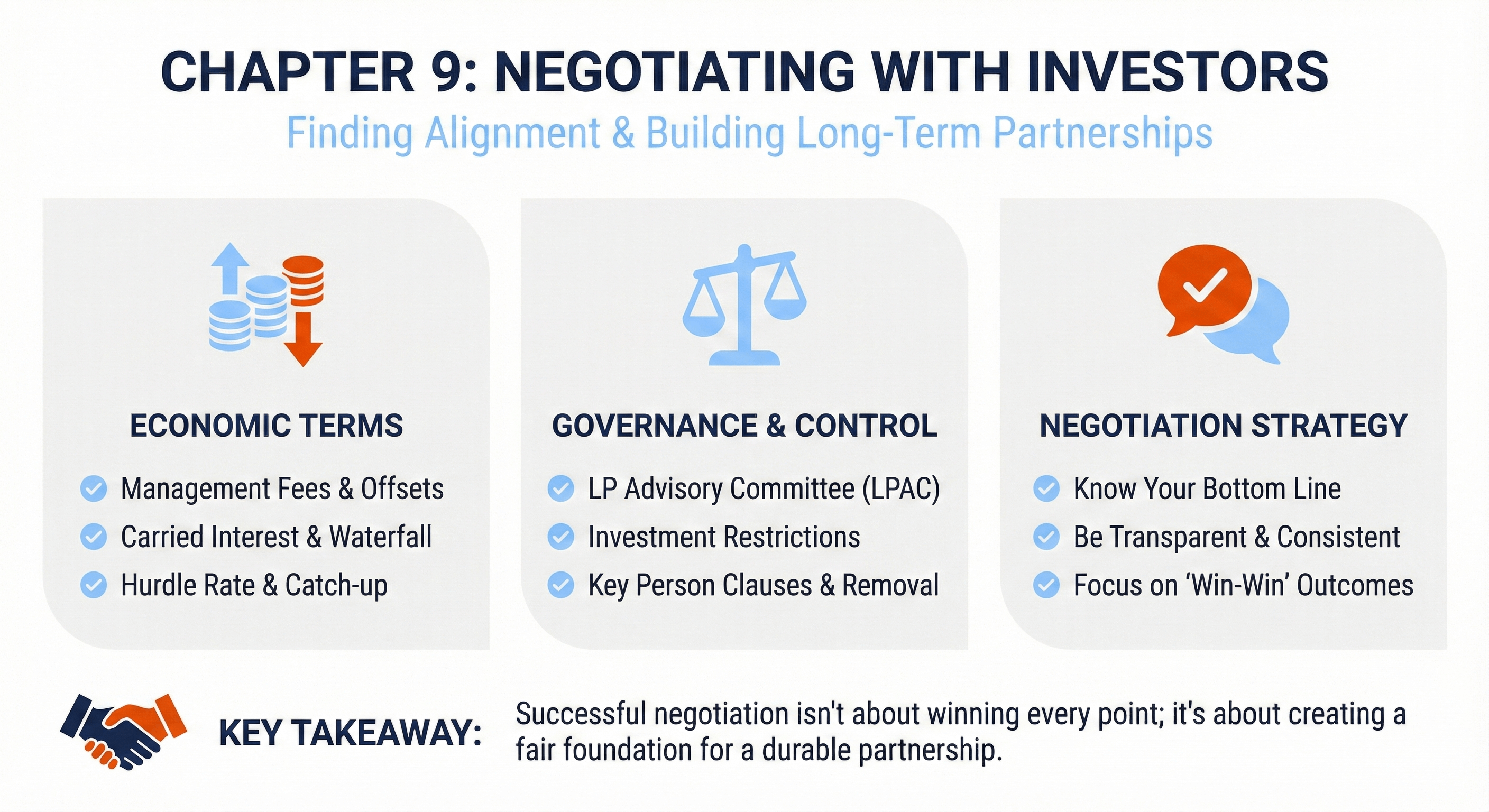

In this chapter, we’ll discuss everyone’s favorite topic: negotiation tactics. After the GP finishes the first draft of the fund documents, they send the documents to potential LPs and cross their fingers. At this point, the LPs have three options:
- Invest
- Don’t invest
- Indicate interest, but negotiate for better terms
TO DEAL OR NOT TO DEAL?
If an LP chooses Door #3 above and attempts to negotiate, the GP has three options:
- Decline the attempt to negotiate (“Take it or leave it!”)
- Change the terms of the LPA
- Enter into a “side letter” with one or more LP
CHANGING THE TERMS OF THE FUND DOCUMENTS
The simplest way to negotiate is to revise the fund documents. For example, let’s say the fund has a management fee percentage of 2 percent, but an LP wants a management fee percentage of 1.5 percent. The GP could revise the LPA, changing the definition of “management fee percentage” from 2 percent to 1.5 percent. Easy!
In this example, the new 1.5 percent management fee percentage would apply to all LPs in the fund. It’s a major change to the GP’s fee income (a fund-wide haircut on fees).
SIDE LETTERS
Changing the fund documents to appease one LP as described above is like using a flamethrower to kill a housefly. It’s not targeted and may result in collateral damage. If you have one LP who wants a fee reduction from 2 percent to 1.5 percent, why not give just that single LP a fee reduction?
You can! You just need a side letter. A side letter is a bilateral contract between the fund and a single LP where the LP gets special rights not granted to the other LPs.
HOW TO NEGOTIATE SIDE LETTERS
Let’s take a deep dive into the exclusive, bespoke club of side-letter negotiations.
WHEN ARE SIDE LETTERS NEGOTIATED?
In many cases, LPs present their side-letter requests to the fund early in the negotiation process. Sophisticated LPs often have a “form” side letter they send to every fund. If you’re an LP in a lot of deals, you might consider working with your lawyer to draft a form side letter.
After the LP sends their form side letter, the GP and LP typically negotiate the LPA and the side letter in parallel. In certain cases, some side-letter requests might make their way into the LPA itself and vice versa, as discussed below.
GP STRATEGIES FOR SIDE-LETTER ADMINISTRATION
If you aren’t careful, side letters can get out of control. Three ways to reduce your side-letter nightmares include:
- Decline Side Letters: Don’t be afraid to “just say no.”
- Avoid MFNs: Don’t give out most-favored-nations provisions unless strategically necessary.
- Copy + Paste: Use identical wording for common administrative requests.
WHAT DO INVESTORS PUT IN SIDE LETTERS?
LP side-letter requests typically fall into two overall buckets:
- Preferential Terms: Fee discounts, carry breaks, co-invest rights, etc.
- Administrative Terms: Tax, regulatory, confidentiality, or structural needs.
Sample Preferential Terms in Side Letters
1. Most-Favored Nations (MFN)
An MFN lets an LP review all other side letters and adopt rights granted to others, subject to common limits:
- size-based restrictions
- GP-affiliate carveouts
- carveouts for tax or regulatory terms
⚠ FUND TRAP #9: AGREEING TO LOOSEY-GOOSEY MFNS
MFNs are powerful and risky. Use sparingly.
2. Reduced Management Fees
Example: 2% → 1%.
3. Reduced Carried Interest
Example: 20% → 15%.
4. Co-Investment Rights
LPs may get pro rata rights on follow-on deals or special fee terms.
5. Pro Rata Rights in Future Funds
LPs may get allocation rights in successor funds.
6. LPAC Rights
Large LPs may request a voting seat or observer seat on the Limited Partner Advisory Committee.
Sample Administrative Terms in Side Letters
1. Excluded Investments
Examples include bans on:
- alcohol
- gambling
- firearms
- fossil fuels
- crypto
- non-US assets
2. Affiliate Transfers
LPs may transfer interests to affiliates without GP consent.
3. Confidentiality Terms
Limits on disclosure of LP identity or fund info.
4. Tax & Regulatory Requirements
Common for non-US, tax-exempt, or government LPs.
MOVING NEGOTIATION REQUESTS FROM THE LPA TO A SIDE LETTER
If an LP asks for something the GP doesn’t want to add to the LPA, placing the term in a side letter is often the cleanest solution.
Example:
An LP requests an organizational expense cap → easier to put in a side letter than amend the LPA.
TIPS FOR NEGOTIATING SPECIFIC FUND TERMS
Classes of Limited Partners
Funds may create classes (e.g., Class A / Class B) based on check size to offer economic incentives.
1. Carried Interest & Management Fees
Tips for GPs:
- Reward larger investors with reduced fees/carry.
- Avoid management-fee offsets.
- Do not give slices of carried interest to LPs.
- Use GP catch-ups to protect economics.
Tips for LPs:
- Ask for reduced fees/carry or higher preferred returns.
- Request fee reductions after term extensions.
- Build in offsets for transaction or placement fees.
- Large LPs may request a piece of carry.
2. Subsequent Closings
Tips for GPs:
- Offer incentives for early investors.
Tips for LPs:
- Ask GPs to waive interest/late-fee “catchup” obligations.
3. Fund Expenses
Tips for GPs:
- Keep fund expenses broad but reasonable.
Tips for LPs:
- Remove inappropriate expenses (GP salaries, offices).
- Ask for caps on organizational expenses.
4. GP Removal
Tips for GPs:
- Allow only “for cause” removal.
- Require high voting thresholds.
- Use a narrow definition of “cause.”
Tips for LPs:
- Request both “for cause” and “no-fault” removal.
- Push for lower voting thresholds.
- Use broad “cause” definitions.
5. Co-Investments
Tips for GPs:
- Allocate co-invests at GP discretion.
- Charge whatever fees/carry you deem appropriate.
Tips for LPs:
- Request pro rata rights.
- Negotiate reduced or waived fees/carry.
Once all your LPs are on board, it’s time for the big day—the initial closing! In the next chapter, we’ll discuss how to successfully navigate this most exciting day.
More Fundamentals Chapters
Let's Build Something Together
Please provide some background on yourself, your track record (if applicable), and your goals. We're excited to get started.
