
What Are the Mechanics for Admitting Investors into a Fund?
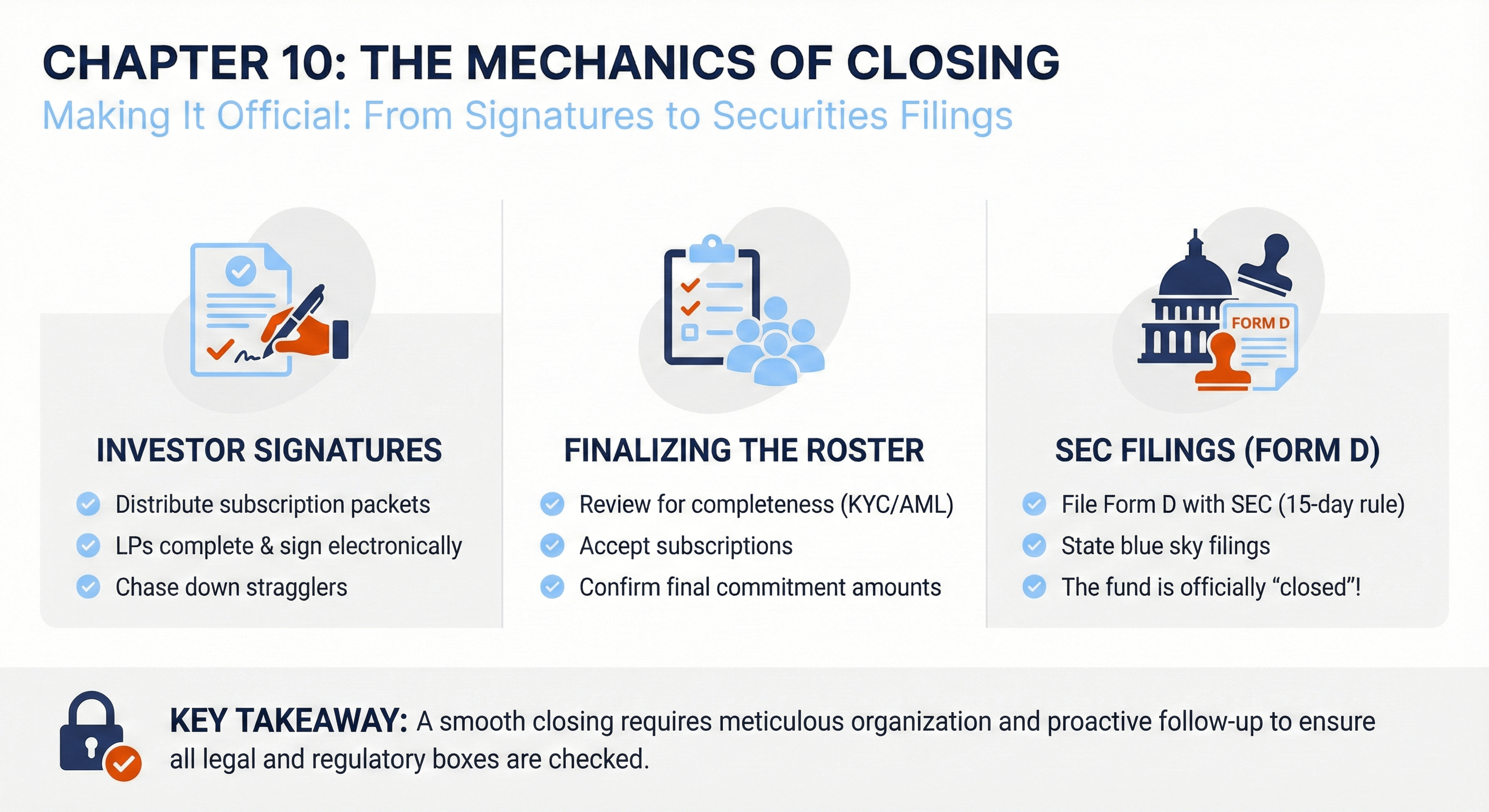

Time to herd the cats! In this chapter, you’re going to learn how to hold your fund’s initial closing. The initial closing date is a big deal for most GPs. It means you’ve raised capital, you’ve found the right deals, and you’re ready to get rolling on the business of the fund.
WHEN ARE YOU READY TO CLOSE?
GPs typically decide to hold the initial closing once they have a critical mass of capital commitments. Most funds don’t raise the entire fund at the initial closing. As described in Chapter 5, funds typically keep fundraising for months (or years) while making their initial investments.
Everyone is different. We’ve seen funds hold initial closings once they’ve secured anywhere from 5 to 100 percent of their target capital commitments—with the majority in the 10–50 percent range. First-time fund managers are usually on the lower end of that range.
The best time to hold your initial closing is as soon as you have enough commitments to start executing on the fund’s strategy. On one hand, you want your investors “locked in” and committed to the fund, but on the other hand, you want to ensure you have enough commitments to make running the fund worth it for you. Additionally, you’ll have bills to pay at the initial closing. Lawyers, administrators, and other service providers often defer a portion of their fees until the fund’s initial closing date.
COMMITTED CAPITAL VS. CAPITAL CONTRIBUTIONS
“Committed capital” refers to how much money your investors have promised to contribute to the fund over the fund’s life. An investor’s capital commitment is typically contained in their subscription agreement.
An LP’s “capital contributions” are how much money the LP has actually sent to the fund.
When you hold the initial closing, each LP’s commitment is locked in, and you now have the legal authority to start requesting capital contributions (to pay for deals, management fees, and other fund expenses). An LP’s capital contributions cannot exceed its capital commitment.
SO…WHEN DO YOU GET THE MONEY?
Some GPs wait until they have a deal ready to close before they hold the fund’s initial closing—and then they call capital immediately. Other GPs elect to hold a “dry closing”—this is where you officially hold the initial closing (where investors legally commit to the fund) but wait to call capital until you have a deal about to close. We’ll discuss capital calls in detail in the next chapter.
WHAT DOCUMENTS NEED TO BE SIGNED AT CLOSING?
The key documents signed at the initial closing are:
- Each investor’s subscription documents (sub docs)
- The fund’s limited partnership agreement (LPA)
- Ancillary documents
We covered these documents in Chapter 8. In this section, we’ll go into detail about who signs what…and when.
SUBSCRIPTION DOCUMENTS (SUB DOCS)
The initial closing officially occurs when you countersign your first investor’s sub docs. Your lawyer should help with this process.
As a GP, you’ll need to review each investor’s sub docs to ensure they’re filled out correctly (and that your LPs are qualified to invest in the fund). Best practice is for you to collect sub docs (signed by the LPs) as they come in and hold them on ice until you’re ready to close. Then, you sign them all at once.
There are many software options available that make signing and reviewing sub docs easy. They cost extra money but reduce headaches considerably. You can also use DocuSign or have investors fill out PDFs, but that can get obnoxious if you have more than a few LPs. Ask your lawyer for suggestions.
You should counter-sign sub docs when you’re ready to hold your fund’s initial closing and not a moment before. Holding the initial closing date triggers certain regulatory filing deadlines (discussed below), so you don’t want to accidentally close before you’re ready.
⚠ FUND TRAP #10: SIGNING WITH GREAT ENTHUSIASM (WITHOUT TELLING YOUR LAWYER)
Despite my warning, some of you lovely GPs will sign the sub docs early and send your poor lawyers into a frenzy. As discussed below, you need to file your Form D and Blue Sky filings within fifteen days of the fund’s initial closing date. If you accidentally counter-sign sub docs early (thereby holding the initial closing early), that fifteen-day clock starts ticking.
If your Blue Sky filings are submitted late, some states will impose a late fee. Don’t be the client that closes a month too early without telling your lawyer!
LIMITED PARTNERSHIP AGREEMENT (LPA)
Unlike the sub docs, the LPs (usually) don’t sign the LPA. The GP signs the LPA on behalf of the LPs. The GP can do this because of a limited power of attorney granted by the LPs to the GP in the sub docs. The GP signs the LPA at the initial closing.
As a reminder from Chapter 8, the LPA signed at the initial closing is the “Amended and Restated LPA.” Your lawyer will typically prepare a very simple “initial LPA” weeks ahead of the initial closing. You can use this initial LPA to open bank accounts and sign other fund-related documents in advance of the initial closing date.
ANCILLARY DOCUMENTS
In addition to the sub docs and the LPA, there are a handful of other agreements and resolutions to sign that “button up” the initial closing, such as:
- Management Services Agreement (appoints the ManCo and establishes fee rights)
- Corporate Resolutions (authorizing creation of the fund and admission of LPs)
- Reg D-Covered Person Questionnaire (to ensure no disqualifying events)
WHAT REGULATORY FILINGS DO YOU NEED TO MAKE?
Even funds relying on exemptions must make at least two filings at the initial closing: Form D and Blue Sky filings.
FORM D
A Form D filing notifies the SEC that you’re selling securities. It must be filed within 15 days of the initial closing.
Steps:
- Form ID: Create an SEC filer account (notarized submission).
- Receive SEC Codes: Needed to access the EDGAR system.
- File Form D: Submit the online form with offering details.
You can also pre-file Form D before the initial closing to reduce stress.
BLUE SKY FILINGS
Each state where your investors reside requires its own filing and fees. These must also be filed within 15 days of your initial closing.
- Filed through NASAA (a centralized system)
- Must file after Form D
- No Blue Sky filing is required for Florida
WHAT ABOUT THE INVESTMENT ADVISERS ACT?
Depending on the fund’s structure and size, additional filings may apply, including:
- Form ADV (for RIAs)
- Form ADV Part 1A (for ERAs)
- State-level filings
See Chapters 14 and 15 for details.
KNOW-YOUR-CUSTOMER / ANTI-MONEY-LAUNDERING
You’ll want to collect KYC/AML information such as:
- Government ID for individuals
- Formation certificates for entities
A third-party administrator can handle this process.
A new rule from FinCEN under the Bank Secrecy Act will require RIAs and ERAs to implement expanded KYC/AML procedures beginning January 1, 2026.
SUMMARY OF CLOSING CHECKLIST
On your fund’s initial closing date, you’ll need to:
- Counter-sign sub docs
- Sign the LPA and ancillary documents
- File Form D
- File Blue Sky filings
- Collect KYC/AML information
- Celebrate! 🎉
Next up, we’ll learn the mechanics of calling capital from your investors once you’ve held the initial closing date.
More Fundamentals Chapters
Let's Build Something Together
Please provide some background on yourself, your track record (if applicable), and your goals. We're excited to get started.
